|
|
|
Suburban Sprawl
Have you noticed that traffic seems to be getting
worse every year? These days, you can't drive through a major metropolitan
area without allowing
an extra hour for traffic, if you happen to be going through there
at peak rush-hour times.
Many drivers will route themselves through major cities at times
when traffic is low, just
to save themselves this aggravation. Many drivers prefer to drive
at night, for this very reason
and who can blame them? Some people try to relate big city traffic jams to
urban sprawl and that is sometimes the case. However, many cities
haven't grown much in the
last ten years and some have even gotten smaller. Philadelphia,
Baltimore, Washington DC, New
Orleans, St. Louis, Cleveland, Milwaukee and Detroit have all went
down in population according
to Census figures. There have been some huge booms though. Las
Vegas has grown by a whopping
85% over the same ten years (1990-2000). Austin, Mesa, Charlotte,
and Colorado Springs, have
all grown at phenominal rates. But most other cities only went
up a few percentage points over
ten years, if that.
So, how come traffic is twice as heavy in these same
cities that supposedly haven't grown much, if at all? The answer
is found in the suburbs. Suburban
sprawl consumes more than 500,000 acres of forest and farmland
each year, according a Seattle
Post-Inteligence article by John Flicker. If the population in
the United States continues
to grow at it's current rate (2,000,000 each year), it can only
get worse.
If you think that's bad, I should warn you that some
other countries have it much worse than we do and we should count
ourselves as some of the
lucky ones. So, before you go packing your bags, you better find
out how bad it is there. The
worlds worst traffic jam occurs during the summer on the road from
Paris to Toulouse, France
where you can expect a back-up for over 600 kilometers, or in American
terms, over 373 miles
long! Tokyo also claims to have the worlds worst traffic jams,
as does Singapore, Tailand and
Lagos, Nigeria. I don't know how to determine who really has the
worst traffic jam anyway.
I mean, what's worse, 10 miles at 1 mph, or 10 blocks at 1 block
per hour?
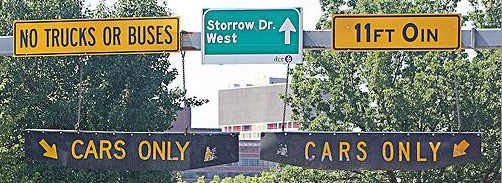
Truck traffic has increased at a greater rate than
cars too. According to a Polk Automotive Inteligence study, in
1994, 35% of the vehicles on
U.S. roads were trucks. And in the year 2000, 40% where trucks.
This rate is expected to grow
in the future. After all, all those suburbanites are going to need
stuff.
Many people think the answer is always more lanes
on the highways, or upper and lower levels, or maybe even separate
lanes for cars and trucks.
I'm sure that is the solution. More space is always the answer.
But most States simply don't
have the money for all that elaborate roadwork. So, we need to
learn to deal with it ourselves.
I think that truckers are the key. They can do something about
it now. I will explain later.
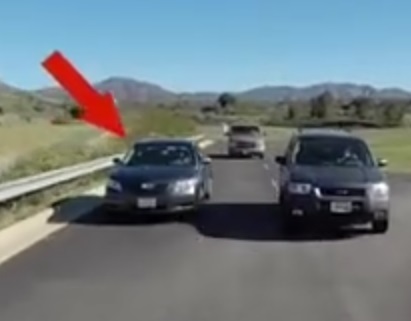
Have you seen these rolling roadblocks? I have been
seeing them an awful lot lately. If you haven't, I'll tell you.
When a road construction job
needs to block one lane, or even the whole road, for (hopefully)
a short time, the police will
"help" them and create a rolling roadblock. Usually two
patrol cars will stop traffic
a few miles away, one blocking each lane. Then, they will (very
slowly) drive toward the construction
area. Of course, this creates a traffic jam behind the patrol cars.
But only because everybody
lines up so close to the vehicle in front of them. Then, when all
these vehicles reach the
jobsite, they usually have to merge into one lane, which causes
a worse jam. Then all the truckers
are cussing out the cops on the CB.
Well, here's what I did only a few weeks ago and it
really worked. I was cruising along when I saw a rolling road block
ahead and everybody was
stacking up behind the police cars. I was about a block behind
them. Although they (the police)
were rolling, I noticed that some of the vehicles between me and
them were stopping periodically.
I got on my CB and told all the truckers to create more rolling
roadblocks. That way, we could
bring some space to this equation. I got next to a truck and we
stayed back about fifty feet
and were able to keep rolling. Several others created their own
rolling roadblocks too. We
had a rolling roadblock about every block. Then, when we reached
the lane closure, everybody
merged smoothly. There were a few truckers who tried to argue with
me when I suggested it,
but enough of them aggreed and we made believers out of the doubters.
So, the next time you see a rolling roadblock, don't
tailgate and ruin it, create another rolling roadblock a few hundred
feet behind them. That
way, you are helping the situation. The cops get it and are trying
to show us how it's done.
Don't let them do all that for nothing. Help make sure it works.
Thanks for reading my column each month. I am happy
to report that my website has grown by leaps and bounds over the
last two years, since I have
been writing for Ten-Four Magazine. When I wrote my first column
in October of 2000, I was
getting an average of twenty visitors per day and most of them
only read another page or two.
At the time, I thought that was pretty good. But now, I get three
to four hundred visitors
a day! It has grown steadily over the last two years. I was excited
last year, when I started
averaging two-hundred visitors a day. That snuck up on me and suprised
me. I have some real
content now, over sixty pages of driving tips, a free online CDL
test, some true stories of
road rage, website building tools and of course all of my past
Ten-Four columns. Once again,
thanks for listening and thanks for visiting www.BigCityDriver.com. Ken Skaggs C 9-02 |
Ten Keys to
Safe City
Driving
™
(Now available on Audio CD- Only $5)
1. Understand Traffic Waves 2. Prevent Traffic
Jams 3. Stay Calm 4.
Do The Math 5. Be Predictable 6. Time Traffic Lights 7. Expect the Expected 8.
Compensate for the Ignorant 9. Teach Others 10. Make Sure an Accident is
Never Your Fault
Read more Here are some satisfied customers-
*Old Dominion
Freight
Line
*Plastic Express
*Dart Container Corp.
*Van-Pak
Trucking
*GD
Eastlick Trucking
Inc.
*Alex Express
*Kenny Smith Trucking
*and many more.
|